Participation in IAHR-APD 2026 and Visit to KICT River Experiment Center (Incheon, South Korea)
Participation in IAHR-APD 2026 (Songdo, Incheon, South Korea)
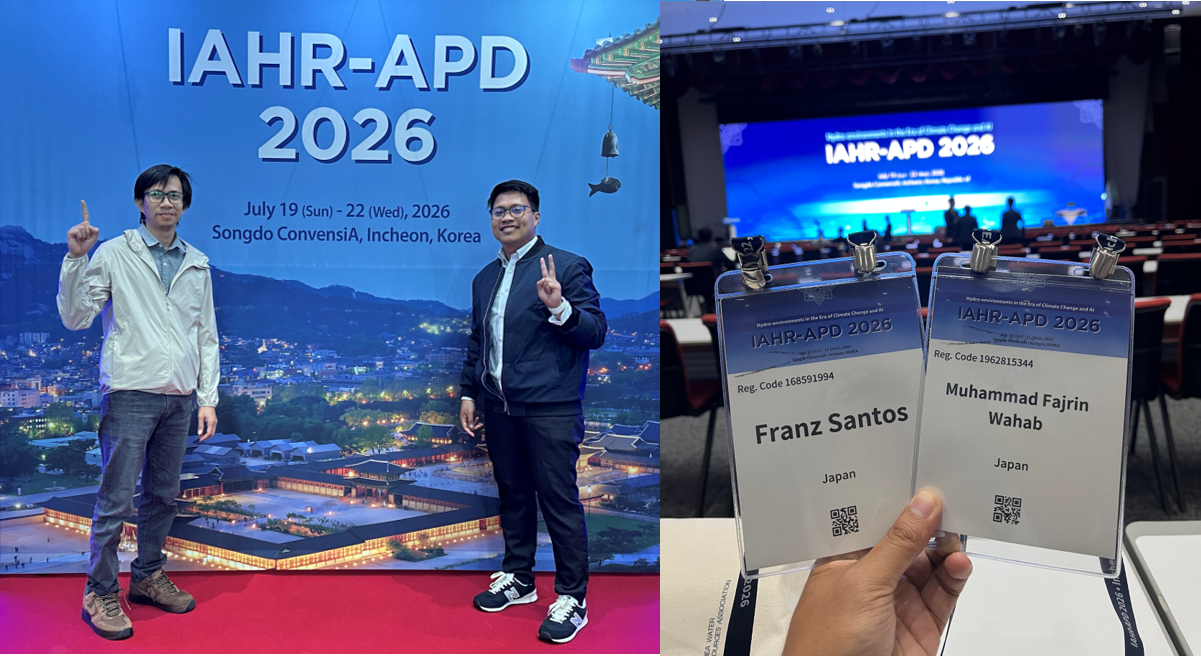
From July 19 to 22, 2026, Professor Tatsuhiko Uchida and students of the Hydraulic Engineering Laboratory Muhammad Fajrin Wahab (D2) and Franz Santos (D1) participated in the 25th Congress of International Association for Hydro-Environment Engineering and Research – Asia Pacific Division (IAHR-APD 2026), held in Incheon, South Korea.
The IAHR-APD Congress is an international research conference that brings together researchers, engineers, and practitioners across the Asia Pacific region to exchange advances and knowledge in hydraulics, water resources, river engineering, and hydro-environmental science.
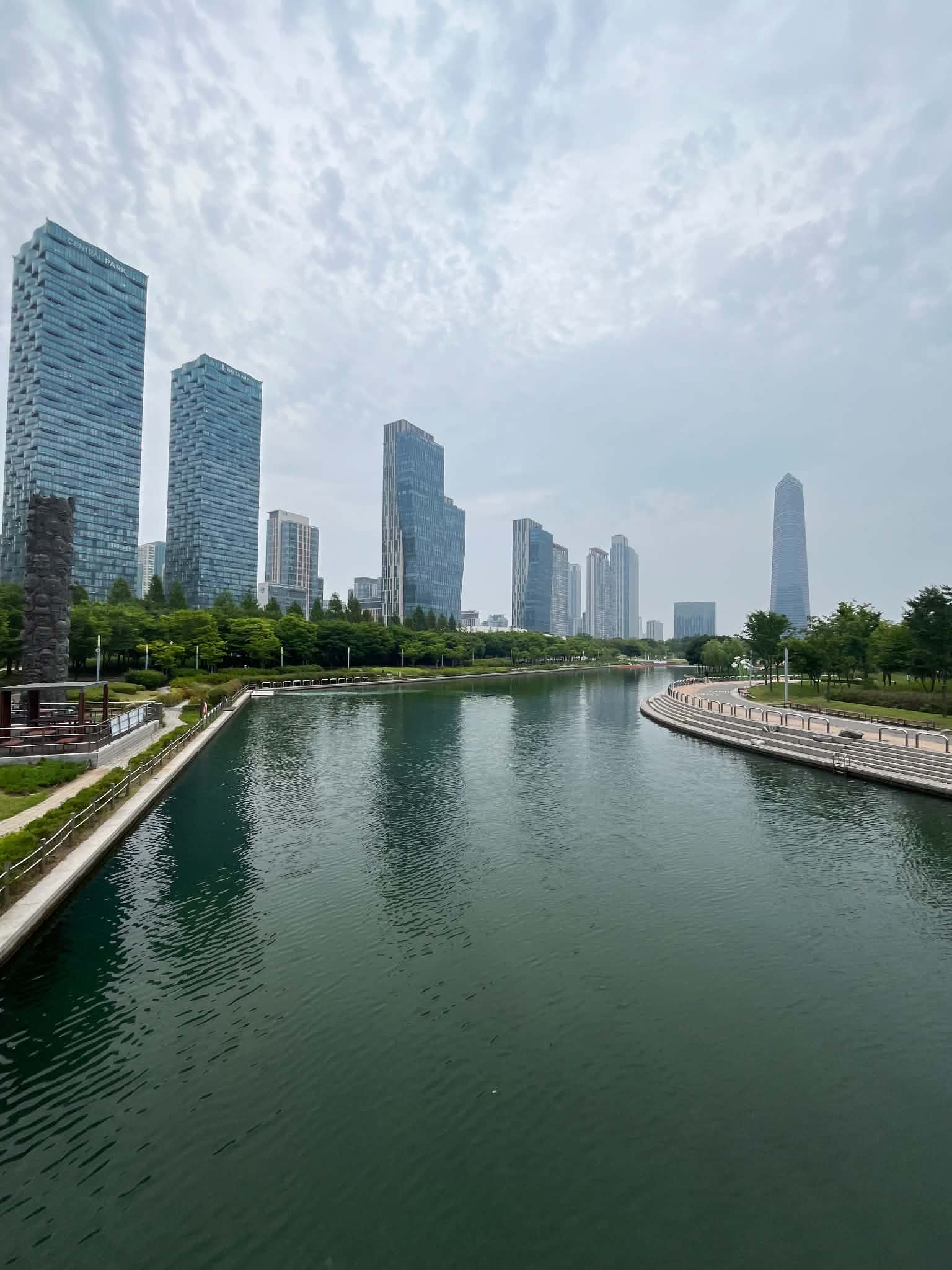
This year, the IAHR-APD Congress is held at Songdo (Songdo International Business District) in Incheon, South Korea. The location depicts a modern waterfront smart city developed on reclaimed land, known for its contemporary architecture, green urban spaces, and role as an international hub for business, research, and global events.
This was our first International Conference as Doctoral Students so we were both excited and nervous to present our research in front of other researchers and experts in the field of hydraulics and river engineering.
Professor Uchida delivered a talk under the special session topic of Multidisciplinary Research and Implementation Strategies for Nature-Based Flood Management. Listening to these keynote lectures, special sessions, and other research presentations specifically those related to our own research really gave us added motivation and ideas to really do our best!
In between the technical presentations, there were also poster sessions and exhibit booths that we visited and where we were able to meet prominent researchers in the field of hydraulics. We were also able to see the value of attending a research conference in terms of making new acquiantances, establishing network, and fostering potential future collaborations.
We presented both during the last day of the conference and were oral presentations. Since it was both our first time attending and presenting at an international conference, we felt nervous. To add to that feeling, we saw many prominent experts entering our session rooms and it got us even more excited but also nervous.
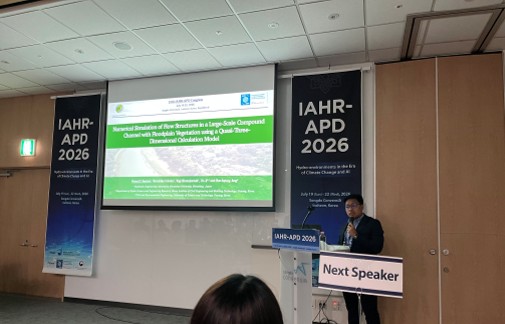
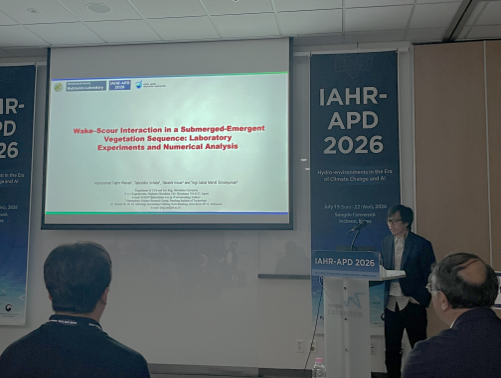
Both of us were able to finish within the alloted time and during the discussion session, we received questions which tackled some of our numerical modeling results. At first it was a bit overwhelming since it was our first time but fortunately, we were able to clarify and answer the questions. This experience we will bring with us in future conferences and will drive us even more to do our best in research!
River Observations
Seunggi-cheon, Incheon
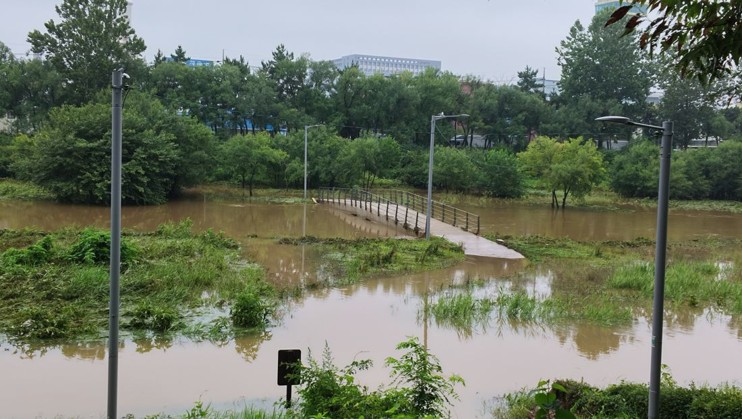
The first river we visited was Seunggi-cheon, an urban stream in Incheon running between Yeonsu-gu and Namdong-gu that discharges through the Namdong Retention Basin toward the Songdo tidal flats. It is about 6.20 km long, drains 33.58 km² and is roughly 80 m wide. It has a compound cross-section, with a jogging track on the wide floodplains and dense vegetation on both the banks and the floodplains. The heavy rainfall of the previous day was enough to cause sudden overtopping. When we arrived, the flow had already spread across the entire floodplain and had submerged the jogging track and the pedestrian bridge.
Hangang River, Seoul
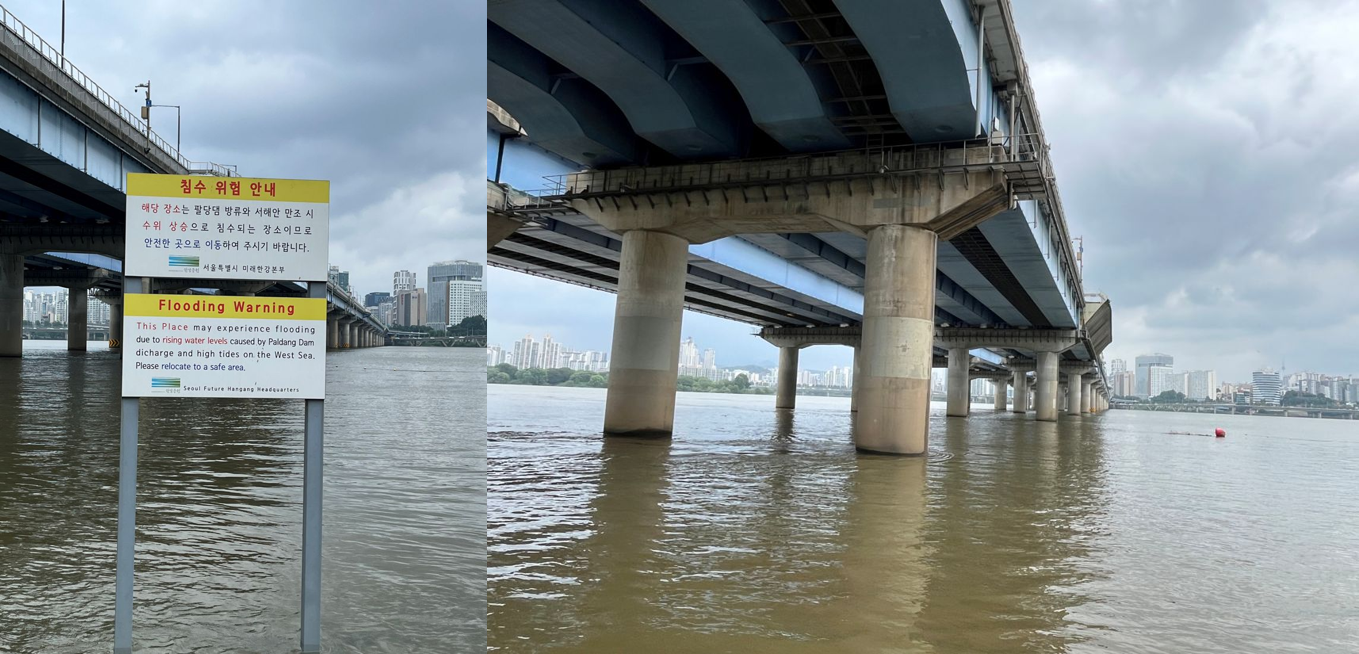
The second was the Hangang, one of the widest rivers in Korea, which flows through the centre of Seoul toward the West Sea near Gimpo. It is about 515 km long with a basin area of 26,018 km². The river was in high flow. Its water level is not governed by the upstream discharge alone, because the reach toward Gimpo and the estuary is increasingly affected by the tide. The signs along the waterfront are simply a warning to the public in case the water level rises during high tide.
Visit to the KICT River Experiment Center
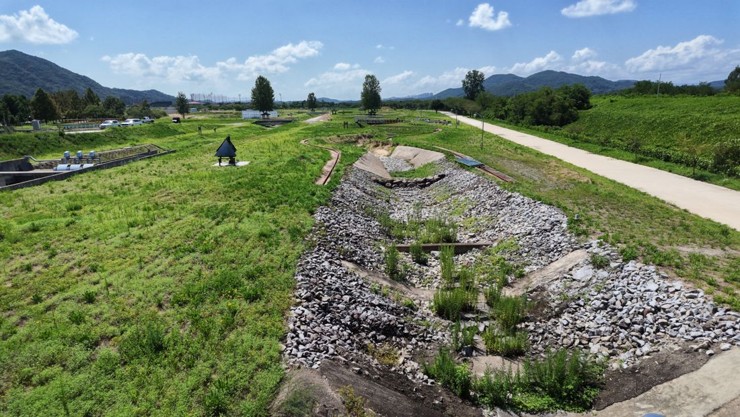
After attending IAHR-APD 2026, we visited the Korean Institute of Civil Engineering and Building Technology (KICT) – River Experiment Center (REC) with the lab’s Korean research collaborators for a meeting and tour at the facility. The REC is located in Andong, Gyeongsangbuk-do, a four-hour drive from the congress venue. It is one of the largest outdoor river experiment facilities in the world, and its motto is “Realization of the River Coexisting with Nature and Human”. Rather than small indoor flumes, it consists of full-scale outdoor channels. The site contains a straight and compound channel, a meandering channel and a steep-slope channel, together with a detention basin, a drainage system and carbon capture areas, all served by a pumping station and a research office with an equipment room.
The Pumping Station and Drainage Experiment
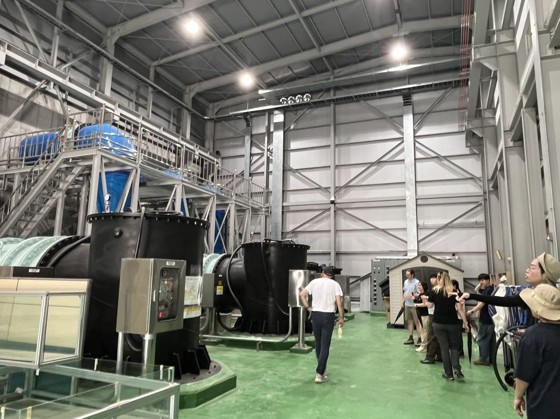
The pumping station is the heart of the facility, with three large pumps of about 10 m³/s (10,000 L/s) in total, which allows the channels to be run close to field scale. A separate area reproduces an urban drainage network at real scale, with manholes and pressure sensors, and is used for drainage performance and flood response tests.
Straight and Compound Experimental Channels
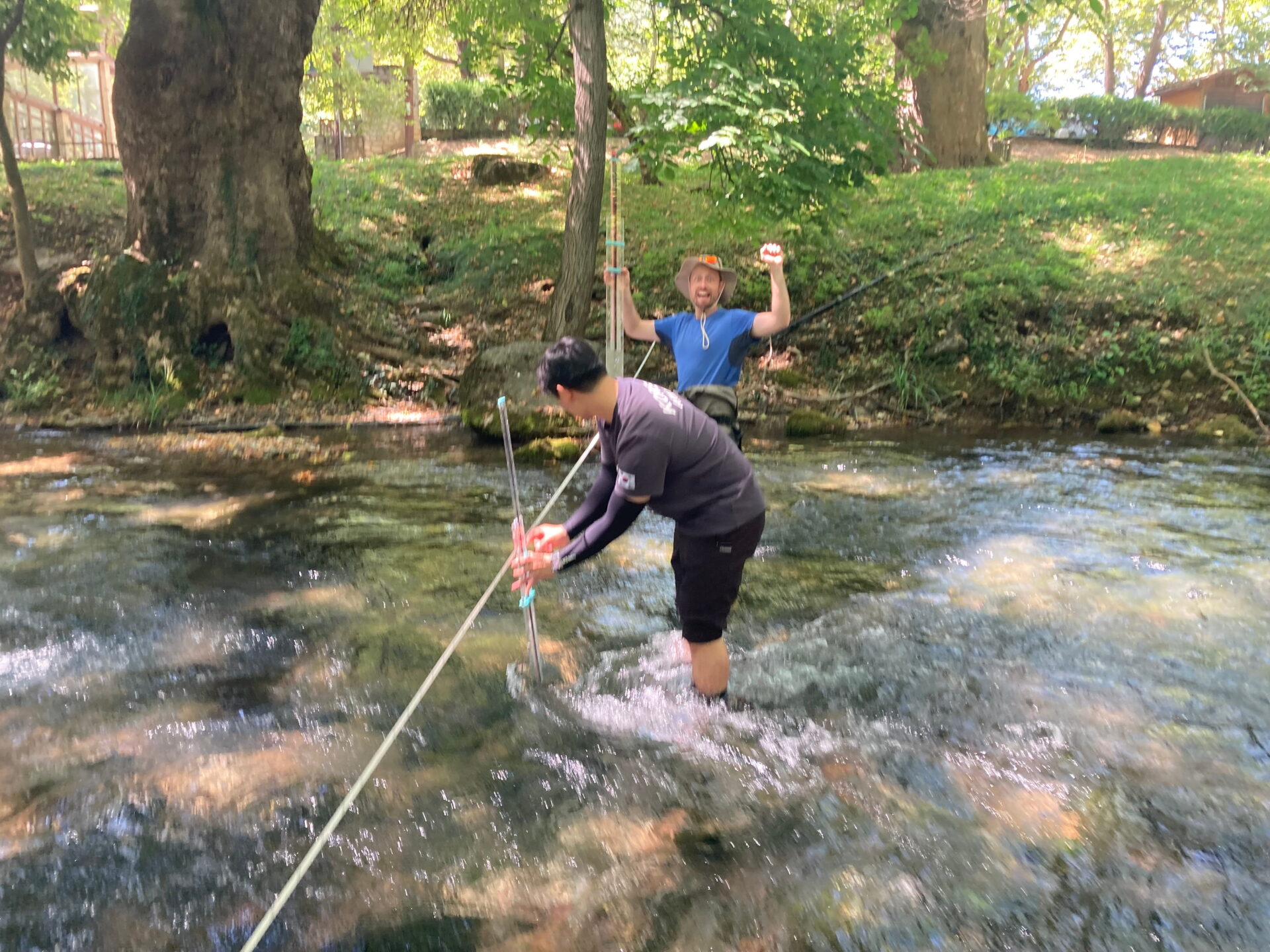
The straight channel is long enough to host several experiments at the same time. In the middle reach, an experiment on flow around a vegetation patch over a movable bed was conducted with several vegetation configurations, and the downstream part can be used for compound channel experiments, which one of our laboratory members uses to validate our model.
Meandering Channel, Detention basin and Carbon Capture Experiment
The meandering channel reproduces a natural planform with a sequence of bends, and connects downstream to the detention basin area, where different riprap and vegetation treatments can be compared under identical hydraulic conditions. Part of the site is also devoted to carbon capture, where instrumented plots measure the carbon captured from the soil and the vegetation volume of each plot.
Our Korean Experience
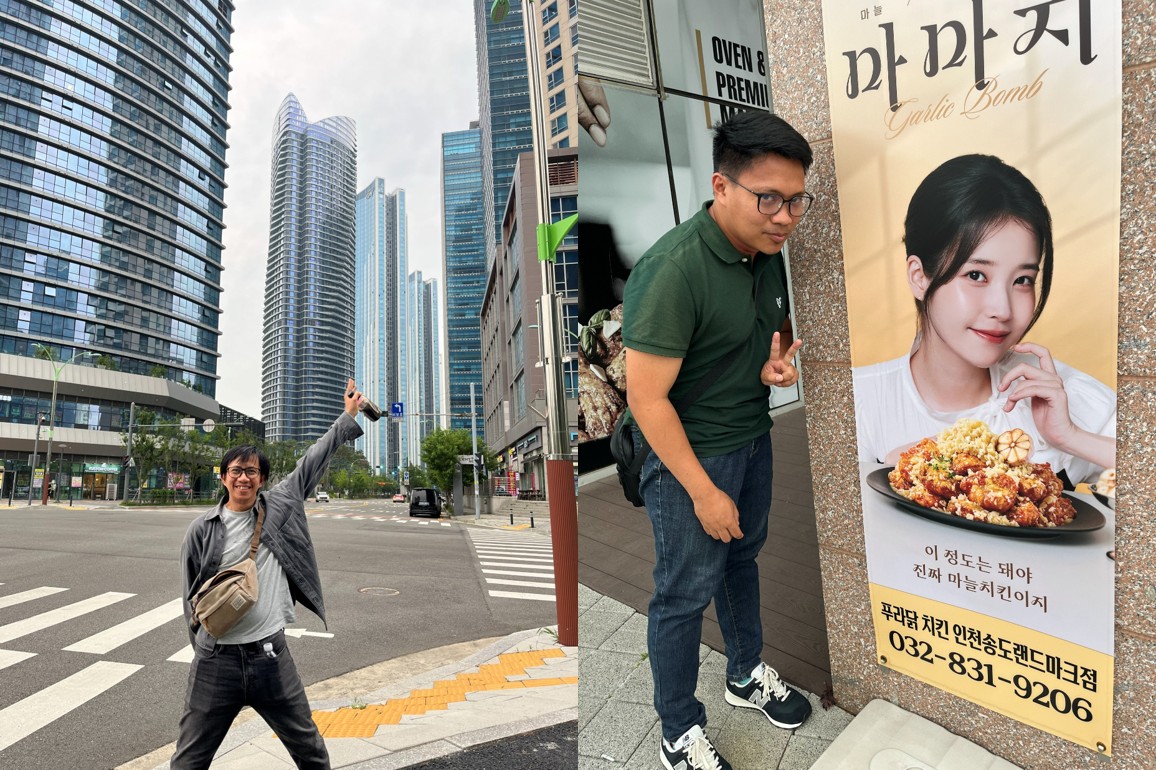
While in South Korea, I had the opportunity to experience Korean food by trying the famous Korean fried chicken and traditional Korean barbecue. It was a memorable experience that allowed me to appreciate Korea’s unique food culture and enjoy some of its most popular dishes.
On our way to river observations, we also were able to walk around the city and enjoy Korea’s balance of development and nature. All in all it was a memorable experience for both of us and we plan to continue doing our best in research so that we would again be able to attend international conferences like IAHR-APD!
Written by
Muhammad Fajrin Wahab and Franz Santos